
Web scraping has evolved from a simple practice of sending raw HTTP requests into an architectural arms race. Today, modern web platforms deploy sophisticated anti-bot mitigation software capable of analyzing everything from your network traffic behavior down to the precise way your virtual browser handles JavaScript execution.
For data engineers and software developers, encountering repeated 403 Forbidden statuses, persistent CAPTCHAs, or temporary IP bans can bring critical data pipelines to an abrupt halt.
Before refactoring your entire proxy infrastructure or spending weeks attempting to patch headless browser instances, it is highly recommended to explore modern, API-driven solutions. You can check the latest availability through the official affiliate page to see how integrated scraping APIs streamline this process.

The Modern Web Scraping Obstacle Course
Traditional scrapers relying on straightforward request libraries are almost instantly flagged by modern web application firewalls (WAFs). To build a resilient data infrastructure, you must understand exactly what your code is up against.
[ Your Scraper ] ---> [ Anti-Bot Firewall ] ---> [ Target Data ]
                           | (Fails JA3/TLS)
                           v
                     [ 403 Forbidden / CAPTCHA ]
Advanced Anti-Bot Mechanisms
TLS/JA3 Fingerprinting: Firewalls analyze the specific parameters used during the initial TLS handshake. If these parameters match known scraping libraries (like Python’s
requestsor Node’saxios), the connection is instantly rejected before any HTML is sent.Behavioral Analysis: Algorithms monitor user behavior patterns such as mouse movements, scrolling speeds, and page-to-page navigation latency to differentiate human traffic from automated scripts.
Canvas and WebGL Rendering Challenges: Anti-bot scripts execute silent background tests on your rendering engine to check if your graphics card and system fonts display elements exactly like a genuine desktop browser.
To safely scale, developers are often forced to choose between manually managing heavy browser clusters or shifting to a managed scraping API.
Key Criteria for Choosing a Scraping Solution
When evaluating an anti-bot bypass framework or API tool, prioritize the following foundational features:
Automated JavaScript Execution: The tool must execute client-side scripts perfectly to extract data from single-page applications (SPAs).
Dynamic Fingerprint Spoofing: It should dynamically rotate user-agents, screen resolutions, OS signatures, and network stacks to mirror true organic browsers.
Intelligent Proxy Layering: High-quality residential and mobile proxies must be natively integrated to prevent broad subnet blocks.
Expert Advice: Do not attempt to build a custom fingerprint rotation matrix from scratch. The engineering overhead required to maintain it against daily anti-bot updates outweighs the infrastructure costs of using a specialized service. Feel free to view current pricing and product details to evaluate pre-configured scaling solutions.
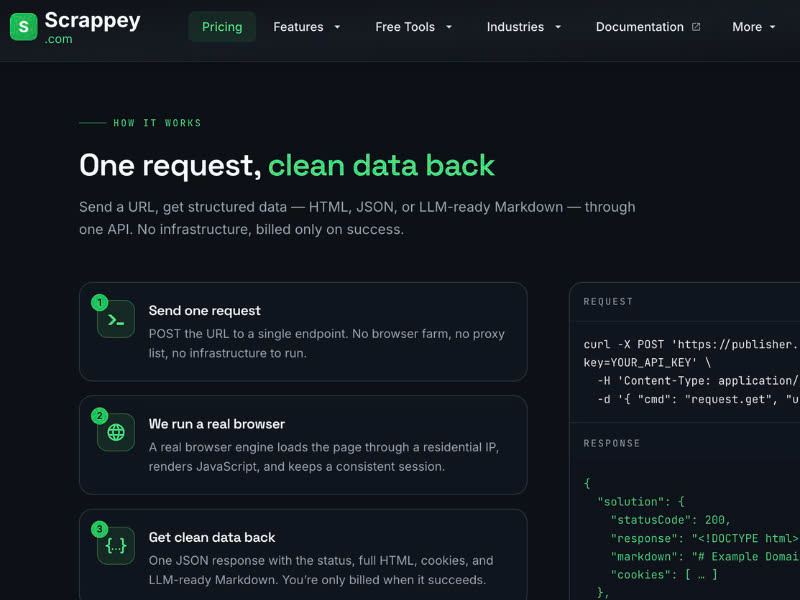
Architecture Comparison: Self-Hosted vs. Managed Scraper APIs
Choosing the right approach depends heavily on your budget, team size, and volume needs.
| Operational Vector | Self-Hosted Headless Clusters (Puppeteer/Playwright) | Managed Anti-Bot Scraping APIs |
| Maintenance Burden | High (constant patching for new anti-bot scripts) | None (handled entirely on the provider side) |
| Infrastructure Costs | High (expensive CPU/Memory for rendering browsers) | Low to Medium (pay-per-request models) |
| Proxy Management | Manual integration and custom rotation logic required | Built-in residential and automated rotation |
| Bypass Success Rate | Decreases as target anti-bot software upgrades | Consistently high due to dedicated patch teams |
To discover the ideal operational balance for your data extraction pipelines, compare available options before making your decision.
Architectural Pros & Cons
Pros
Drastically reduces time-to-market for data extraction pipelines.
Eliminates complex local server infrastructure management.
Provides predictable, volume-based operational costs.
Limitations
Requires transition from pure local script control to structured external API endpoints.
Information regarding internal proprietary bypassing algorithms could not be independently verified, as providers maintain these safeguards under strict confidentiality.
If you are ready to implement a resilient alternative to constant IP blocking, see today’s offers on the official affiliate page.
Frequently Asked Questions (FAQ)
Why am I getting a 403 Forbidden error even when using high-quality residential proxies?
A 403 error often indicates that while your IP address might be clean, your scraper failed browser fingerprint validation, TLS verification, or behavioral analysis checks implemented by the target site’s firewall.
Can managed APIs bypass Turnstile and reCAPTCHA completely?
Yes. Advanced scraping APIs natively solve or bypass modern CAPTCHA and token challenges by presenting valid browser configurations that prevent these verification widgets from triggering in the first place.
Building and maintaining custom code to circumvent modern anti-bot protections is an expensive, uphill battle. Moving the heavy lifting of fingerprint spoofing, proxy rotation, and JS rendering over to a robust, managed API infrastructure ensures your data pipelines remain stable, accurate, and completely unblocked.
To upgrade your existing data extraction pipelines or experiment with developer-friendly anti-bot bypass protocols, explore the complete specifications here.
